

Getting started
Complete these steps before relying on the player for a scheduled session.
1. Know the installation mode
| Workstation | Normal desktop remains in control. Launch D‑Cine Player from the application menu. Network services are not automatically treated as a dedicated appliance. |
|---|---|
| Appliance | Dedicated player account, autologin and player session. Reboot after installation. Do not select this on a general-purpose computer. |
2. Open and sign in
Use the local app. On a running appliance/service, open http://PLAYER-IP:8080/ from an authorised cinema network. The installed private Player Instructions.txt records initial account information. Change default passwords during commissioning.
3. Commission the system
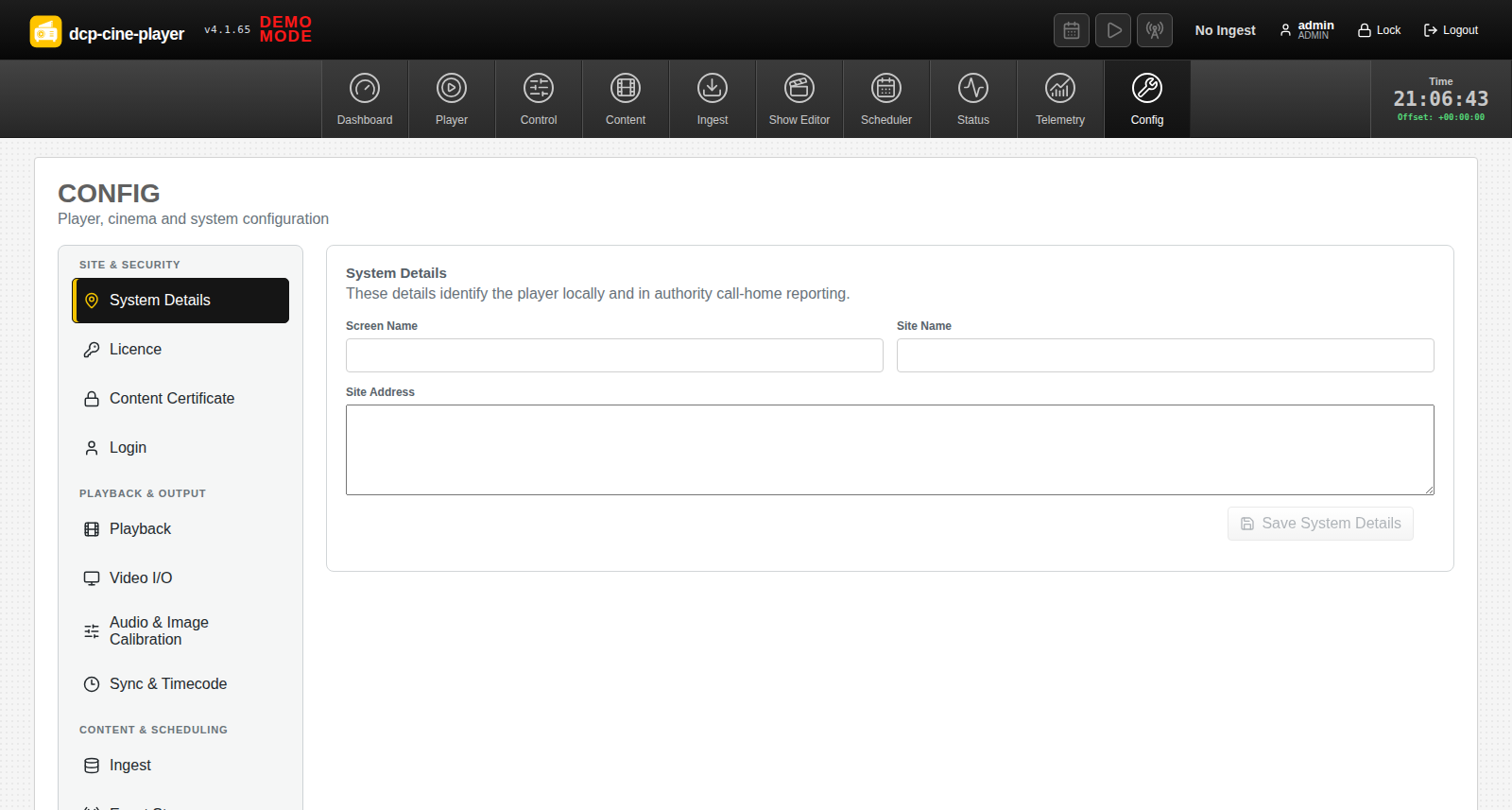
- Open Config → System Details and record site and screen identity.
- Open Config → License and activate a licence or confirm the persistent DEMO MODE overlay. Demo Mode has no session time limit.
- Verify trusted time and timezone before importing time-limited KDMs.
- Select the intended display, output path, audio device and channel profile.
- Run picture patterns and each audio channel from calibration.
- Configure a content source, ingest known-good test material and import its KDM.
- Create a short show, play it manually, then schedule a test start.
- Configure automation only after safe device addresses and cue actions are confirmed.
- Back up identity, licence and configuration according to site policy.
Do not skip output testing. Successful file ingest does not prove the display, HDCP, audio order, processor level or automation wiring is correct.
4. Learn the main pages
Dashboard summarises health. Player controls the active playlist. Content handles media and KDMs. Show Editor builds reusable playlists. Scheduler places shows in time. Config contains commissioning, security and integration settings.
Documentation edition: 6 September 2026. Check procedures against the installed release and venue policy.